
Transportation Management Systems
The owner-operator profitability myth
Why "being your own boss" in trucking costs more than most drivers admit

The Startup Math That Trips Everyone Up
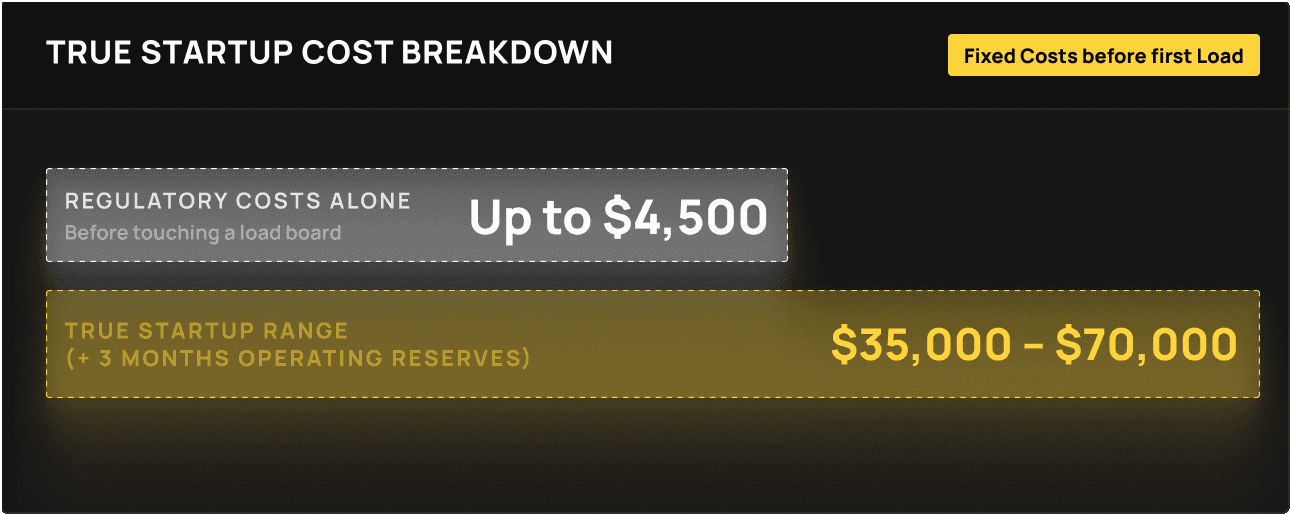
Most new owner-operators calculate the startup cost as a truck payment and first-month insurance. The actual number is significantly higher. Between MC authority ($300), IRP registration ($500 to $2,500), ELD setup ($300 to $1,200), HVUT ($100 to $550), and BOC-3 filing fees ($30 to $100), regulatory startup costs alone can reach $4,500 before you touch a load board. Add three months of operating reserves — the line item that sinks most new operators — and the true startup range runs from $35,000 to $70,000.
The counterargument is that experienced company drivers can often make the transition profitably with careful planning and a cash cushion. That is true. But in a freight market where spot rates have hovered at and below $2.00 per mile, well below the $2.26 industry average cost of operation, "careful planning" is doing enormous work in that sentence. Timing and cost discipline matter as much as, if not more than, experience.
The Calculation Most Operators Skip
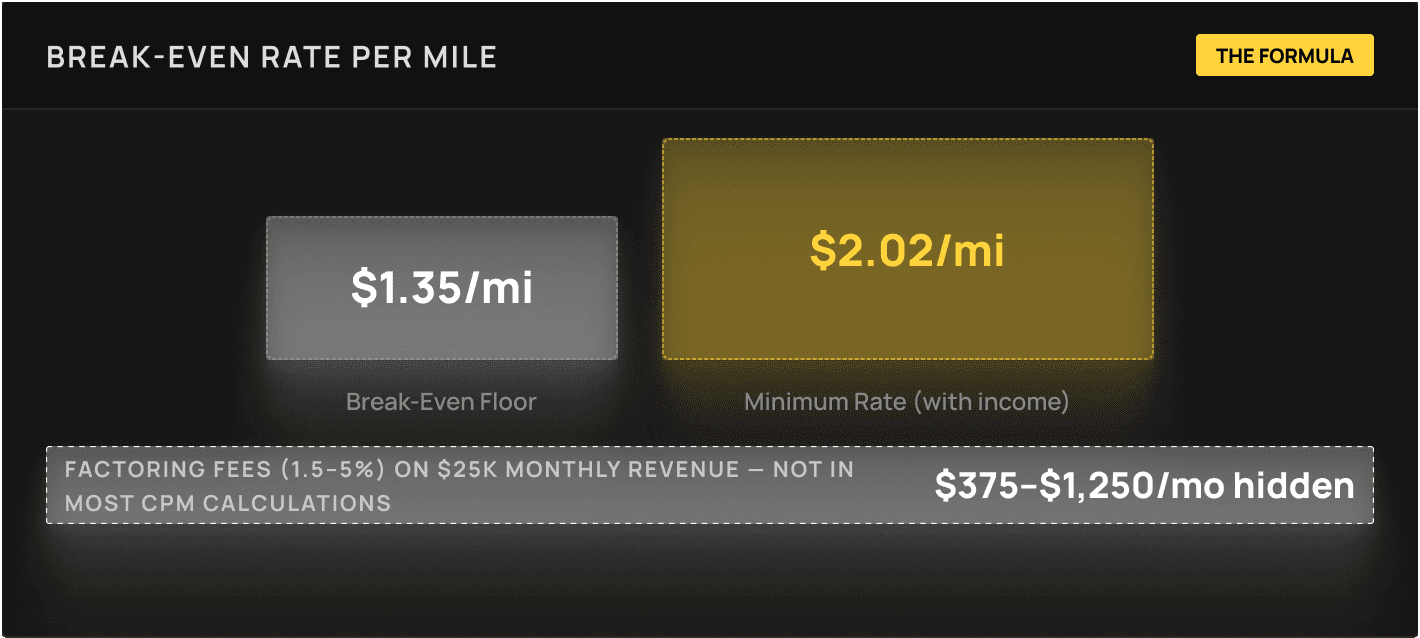
Your break-even rate per mile is the minimum rate at which you do not lose money, and most owner-operators cannot tell you what it is. The formula: total monthly fixed costs divided by monthly miles, plus variable cost per mile. At $5,000 in monthly fixed costs, 10,000 monthly miles, and $0.85 in variable costs, your break-even is $1.35 per mile. Add your target net income, and your minimum acceptable rate climbs to $2.02 per mile all-in, including deadhead.
That $2.02 figure assumes modest income expectations. It assumes no major repairs, no slow weeks, no factoring fees. In reality, factoring companies — which many new operators use to accelerate payment — charge 1.5% to 5% of the invoice amount. On $25,000 in monthly revenue, that is $375 to $1,250 per month in fees that must be included in your CPM calculation or your margin disappears quietly.
What Actually Separates the Operators Who Make It
The operators who build sustainable one-truck businesses share three habits. They know their cost per mile to the penny and update it monthly. They evaluate every load on all-in rate per total mile, not a headline rate per loaded mile, and they maintain a hard minimum below which they do not haul. Lastly, they run three separate reserve accounts: operating, maintenance, and tax.
None of this is complicated. None of it requires a business degree. What it requires is the discipline to run the numbers every month instead of assuming that a full schedule equals a profitable one. A truck that is always moving is not necessarily a truck that is making money. If the rate on every load is below your break-even point, you are not building a business. You are financing someone else's supply chain at a personal loss.
Bottom Line
Owner-operator income is real. The independence is real. But the business management is not optional, and treating it like it is will cost you everything you invested to get on the road. If you need help accomplishing this, contact -
support@hemut.com
The Startup Math That Trips Everyone Up
Most new owner-operators calculate the startup cost as a truck payment and first-month insurance. The actual number is significantly higher. Between MC authority ($300), IRP registration ($500 to $2,500), ELD setup ($300 to $1,200), HVUT ($100 to $550), and BOC-3 filing fees ($30 to $100), regulatory startup costs alone can reach $4,500 before you touch a load board. Add three months of operating reserves — the line item that sinks most new operators — and the true startup range runs from $35,000 to $70,000.
The counterargument is that experienced company drivers can often make the transition profitably with careful planning and a cash cushion. That is true. But in a freight market where spot rates have hovered at and below $2.00 per mile, well below the $2.26 industry average cost of operation, "careful planning" is doing enormous work in that sentence. Timing and cost discipline matter as much as, if not more than, experience.
The Calculation Most Operators Skip
Your break-even rate per mile is the minimum rate at which you do not lose money, and most owner-operators cannot tell you what it is. The formula: total monthly fixed costs divided by monthly miles, plus variable cost per mile. At $5,000 in monthly fixed costs, 10,000 monthly miles, and $0.85 in variable costs, your break-even is $1.35 per mile. Add your target net income, and your minimum acceptable rate climbs to $2.02 per mile all-in, including deadhead.
That $2.02 figure assumes modest income expectations. It assumes no major repairs, no slow weeks, no factoring fees. In reality, factoring companies — which many new operators use to accelerate payment — charge 1.5% to 5% of the invoice amount. On $25,000 in monthly revenue, that is $375 to $1,250 per month in fees that must be included in your CPM calculation or your margin disappears quietly.
What Actually Separates the Operators Who Make It
The operators who build sustainable one-truck businesses share three habits. They know their cost per mile to the penny and update it monthly. They evaluate every load on all-in rate per total mile, not a headline rate per loaded mile, and they maintain a hard minimum below which they do not haul. Lastly, they run three separate reserve accounts: operating, maintenance, and tax.
None of this is complicated. None of it requires a business degree. What it requires is the discipline to run the numbers every month instead of assuming that a full schedule equals a profitable one. A truck that is always moving is not necessarily a truck that is making money. If the rate on every load is below your break-even point, you are not building a business. You are financing someone else's supply chain at a personal loss.
Bottom Line
Owner-operator income is real. The independence is real. But the business management is not optional, and treating it like it is will cost you everything you invested to get on the road. If you need help accomplishing this, contact -
support@hemut.com
The Startup Math That Trips Everyone Up
Most new owner-operators calculate the startup cost as a truck payment and first-month insurance. The actual number is significantly higher. Between MC authority ($300), IRP registration ($500 to $2,500), ELD setup ($300 to $1,200), HVUT ($100 to $550), and BOC-3 filing fees ($30 to $100), regulatory startup costs alone can reach $4,500 before you touch a load board. Add three months of operating reserves — the line item that sinks most new operators — and the true startup range runs from $35,000 to $70,000.
The counterargument is that experienced company drivers can often make the transition profitably with careful planning and a cash cushion. That is true. But in a freight market where spot rates have hovered at and below $2.00 per mile, well below the $2.26 industry average cost of operation, "careful planning" is doing enormous work in that sentence. Timing and cost discipline matter as much as, if not more than, experience.
The Calculation Most Operators Skip
Your break-even rate per mile is the minimum rate at which you do not lose money, and most owner-operators cannot tell you what it is. The formula: total monthly fixed costs divided by monthly miles, plus variable cost per mile. At $5,000 in monthly fixed costs, 10,000 monthly miles, and $0.85 in variable costs, your break-even is $1.35 per mile. Add your target net income, and your minimum acceptable rate climbs to $2.02 per mile all-in, including deadhead.
That $2.02 figure assumes modest income expectations. It assumes no major repairs, no slow weeks, no factoring fees. In reality, factoring companies — which many new operators use to accelerate payment — charge 1.5% to 5% of the invoice amount. On $25,000 in monthly revenue, that is $375 to $1,250 per month in fees that must be included in your CPM calculation or your margin disappears quietly.
What Actually Separates the Operators Who Make It
The operators who build sustainable one-truck businesses share three habits. They know their cost per mile to the penny and update it monthly. They evaluate every load on all-in rate per total mile, not a headline rate per loaded mile, and they maintain a hard minimum below which they do not haul. Lastly, they run three separate reserve accounts: operating, maintenance, and tax.
None of this is complicated. None of it requires a business degree. What it requires is the discipline to run the numbers every month instead of assuming that a full schedule equals a profitable one. A truck that is always moving is not necessarily a truck that is making money. If the rate on every load is below your break-even point, you are not building a business. You are financing someone else's supply chain at a personal loss.
Bottom Line
Owner-operator income is real. The independence is real. But the business management is not optional, and treating it like it is will cost you everything you invested to get on the road. If you need help accomplishing this, contact -
support@hemut.com
Transform your freight operations and leap ahead of the competition.
© Hemut co All Rights Reserved 2026
Transform your freight operations and leap ahead of the competition.
© Hemut co All Rights Reserved 2026
Transform your freight operations and leap ahead of the competition.
© Hemut co All Rights Reserved 2026