Transportation Management Systems
The Real Cost of Fleet GPS Tracking And Why Most Fleets Overpay
Fleet GPS tracking often costs far more than its advertised monthly fee, and the real expense lies in the hidden inefficiencies, manual work, and fragmented tools that keep operations from actually improving.

Hardware, Contracts, and Hidden Add-Ons
The reason is simple: GPS tracking pricing is rarely transparent. What looks like a single
monthly fee is usually just one part of a much larger cost structure. There’s the hardware itself, which can range anywhere from $50 to over $300 per vehicle. Then there’s
installation, whether outsourced or handled internally, which adds both direct expenses and operational downtime. On top of that, you have the recurring subscription fees, typically between $20 and $50 per vehicle per month, which scale quickly as your fleet grows. Many providers also require long-term contracts, locking you in for one to three years, even if the system doesn’t deliver the value you expected. And then come the extras: advanced features hidden behind data usage charges, onboarding fees, and support costs that weren’t clearly outlined at the start.
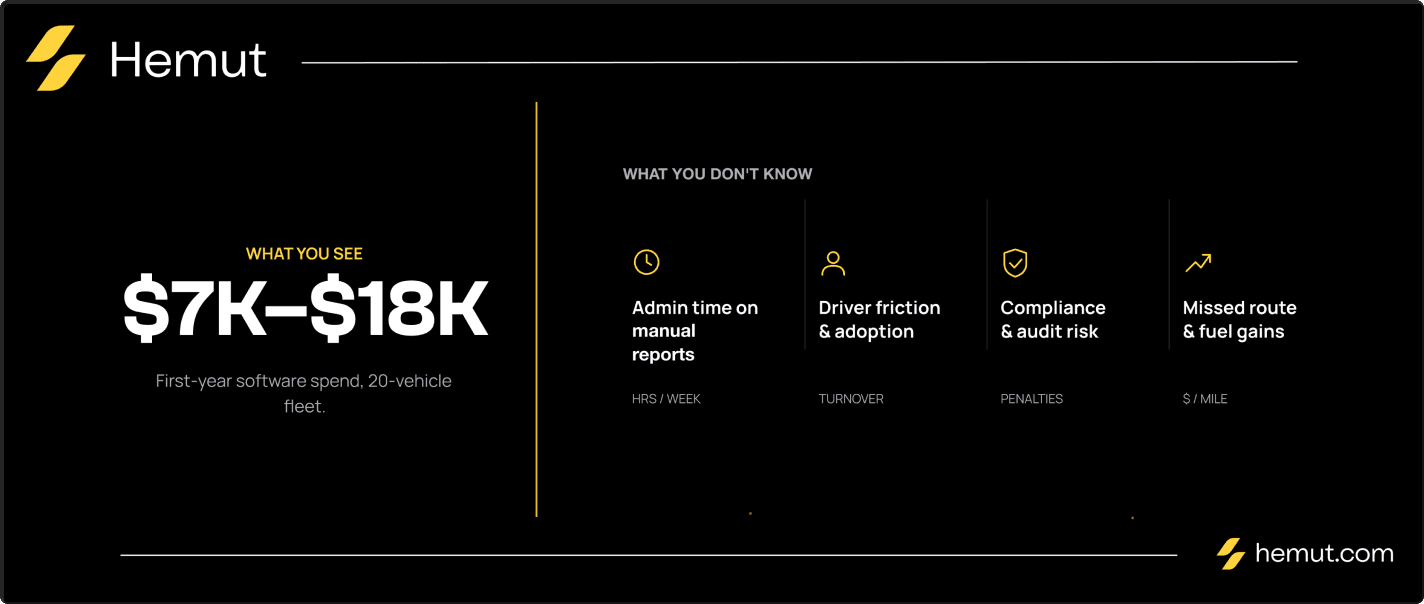
When you add everything up, the numbers escalate quickly. For a modest fleet of 20 vehicles, you could easily spend between $7,000 and $18,000 in the first year alone. But even that doesn’t tell the full story, because the most significant costs are often the ones that don’t show up on an invoice.
Time Is the Tax You Didn't See Coming
Time, for example, is one of the biggest hidden expenses. Many fleet tracking systems still require manual route planning, constant monitoring, and switching between multiple tools. Instead of simplifying operations, they introduce additional layers of complexity. Teams end up working around the software rather than benefiting from it. The result is inefficiency, vehicles idling longer than necessary, routes that aren’t fully optimized, and decisions that take too long to execute. In these cases, GPS tracking may improve visibility, but it doesn’t necessarily improve productivity.
This is where many fleets fall into a common trap. Choosing the cheapest option seems like the logical decision at the start. But low-cost systems often provide only basic tracking, without meaningful optimization or automation. Your team still has to handle most of the work manually, and over time, you may need to add additional tools to fill the gaps. What started as a cost-saving decision turns into a fragmented, expensive setup that fails to solve the original problem. You’re paying for tracking, yet your operations haven’t actually improved.
The truth is that most fleet operators aren’t looking for more data or better maps. They’re
looking for less manual work, faster planning, and better outcomes. They want to reduce the time spent on repetitive tasks and make smarter decisions without constantly digging through dashboards. In other words, they’re not just searching for visibility, they’re shooting for efficiency.
The Industry Shift: From Tracking to Taking Action
That’s why the industry is starting to shift. GPS tracking was an important step forward, but on its own, it’s no longer enough. Modern fleet operations require more than the knowledge of where vehicles are in real time. They require systems that can act on that information, automate processes, and connect different parts of the workflow into a single, streamlined experience. The real return on investment doesn’t come from tracking, it comes from what you’re able to do with that data.
If your current system still relies heavily on manual input, forces you to use multiple
disconnected tools, or doesn’t meaningfully reduce your workload, there’s a good chance you’re overpaying. And that overpayment isn’t just financial. It shows up in wasted time, missed opportunities, and operational friction that slows your business down.
Future of Fleet Management: Subtraction, Not Addition
The future of fleet management isn’t about adding more layers of technology. It’s about
removing unnecessary work. It’s about replacing outdated, fragmented systems with solutions that actually simplify how your team operates. Because in the end, the real cost of fleet GPS tracking isn’t the monthly fee, it’s the hidden inefficiencies that cost you time, drain productivity, and keep you overpaying every single day.
Bottom Line
wasted time, manual work, and operational friction caused by systems that track vehicles but don't actually streamline the work around them. Save 12 hours a week, and see a 52% reduction in software spend when switching to Hemut. Use the full potential of these tools now by Booking A Call

Hardware, Contracts, and Hidden Add-Ons
The reason is simple: GPS tracking pricing is rarely transparent. What looks like a single
monthly fee is usually just one part of a much larger cost structure. There’s the hardware itself, which can range anywhere from $50 to over $300 per vehicle. Then there’s
installation, whether outsourced or handled internally, which adds both direct expenses and operational downtime. On top of that, you have the recurring subscription fees, typically between $20 and $50 per vehicle per month, which scale quickly as your fleet grows. Many providers also require long-term contracts, locking you in for one to three years, even if the system doesn’t deliver the value you expected. And then come the extras: advanced features hidden behind data usage charges, onboarding fees, and support costs that weren’t clearly outlined at the start.
When you add everything up, the numbers escalate quickly. For a modest fleet of 20 vehicles, you could easily spend between $7,000 and $18,000 in the first year alone. But even that doesn’t tell the full story, because the most significant costs are often the ones that don’t show up on an invoice.
Time Is the Tax You Didn't See Coming
Time, for example, is one of the biggest hidden expenses. Many fleet tracking systems still require manual route planning, constant monitoring, and switching between multiple tools. Instead of simplifying operations, they introduce additional layers of complexity. Teams end up working around the software rather than benefiting from it. The result is inefficiency, vehicles idling longer than necessary, routes that aren’t fully optimized, and decisions that take too long to execute. In these cases, GPS tracking may improve visibility, but it doesn’t necessarily improve productivity.
This is where many fleets fall into a common trap. Choosing the cheapest option seems like the logical decision at the start. But low-cost systems often provide only basic tracking, without meaningful optimization or automation. Your team still has to handle most of the work manually, and over time, you may need to add additional tools to fill the gaps. What started as a cost-saving decision turns into a fragmented, expensive setup that fails to solve the original problem. You’re paying for tracking, yet your operations haven’t actually improved.
The truth is that most fleet operators aren’t looking for more data or better maps. They’re
looking for less manual work, faster planning, and better outcomes. They want to reduce the time spent on repetitive tasks and make smarter decisions without constantly digging through dashboards. In other words, they’re not just searching for visibility, they’re shooting for efficiency.
The Industry Shift: From Tracking to Taking Action
That’s why the industry is starting to shift. GPS tracking was an important step forward, but on its own, it’s no longer enough. Modern fleet operations require more than the knowledge of where vehicles are in real time. They require systems that can act on that information, automate processes, and connect different parts of the workflow into a single, streamlined experience. The real return on investment doesn’t come from tracking, it comes from what you’re able to do with that data.
If your current system still relies heavily on manual input, forces you to use multiple
disconnected tools, or doesn’t meaningfully reduce your workload, there’s a good chance you’re overpaying. And that overpayment isn’t just financial. It shows up in wasted time, missed opportunities, and operational friction that slows your business down.
Future of Fleet Management: Subtraction, Not Addition
The future of fleet management isn’t about adding more layers of technology. It’s about
removing unnecessary work. It’s about replacing outdated, fragmented systems with solutions that actually simplify how your team operates. Because in the end, the real cost of fleet GPS tracking isn’t the monthly fee, it’s the hidden inefficiencies that cost you time, drain productivity, and keep you overpaying every single day.
Bottom Line
wasted time, manual work, and operational friction caused by systems that track vehicles but don't actually streamline the work around them. Save 12 hours a week, and see a 52% reduction in software spend when switching to Hemut. Use the full potential of these tools now by Booking A Call
Hardware, Contracts, and Hidden Add-Ons
The reason is simple: GPS tracking pricing is rarely transparent. What looks like a single
monthly fee is usually just one part of a much larger cost structure. There’s the hardware itself, which can range anywhere from $50 to over $300 per vehicle. Then there’s
installation, whether outsourced or handled internally, which adds both direct expenses and operational downtime. On top of that, you have the recurring subscription fees, typically between $20 and $50 per vehicle per month, which scale quickly as your fleet grows. Many providers also require long-term contracts, locking you in for one to three years, even if the system doesn’t deliver the value you expected. And then come the extras: advanced features hidden behind data usage charges, onboarding fees, and support costs that weren’t clearly outlined at the start.
When you add everything up, the numbers escalate quickly. For a modest fleet of 20 vehicles, you could easily spend between $7,000 and $18,000 in the first year alone. But even that doesn’t tell the full story, because the most significant costs are often the ones that don’t show up on an invoice.
Time Is the Tax You Didn't See Coming
Time, for example, is one of the biggest hidden expenses. Many fleet tracking systems still require manual route planning, constant monitoring, and switching between multiple tools. Instead of simplifying operations, they introduce additional layers of complexity. Teams end up working around the software rather than benefiting from it. The result is inefficiency, vehicles idling longer than necessary, routes that aren’t fully optimized, and decisions that take too long to execute. In these cases, GPS tracking may improve visibility, but it doesn’t necessarily improve productivity.
This is where many fleets fall into a common trap. Choosing the cheapest option seems like the logical decision at the start. But low-cost systems often provide only basic tracking, without meaningful optimization or automation. Your team still has to handle most of the work manually, and over time, you may need to add additional tools to fill the gaps. What started as a cost-saving decision turns into a fragmented, expensive setup that fails to solve the original problem. You’re paying for tracking, yet your operations haven’t actually improved.
The truth is that most fleet operators aren’t looking for more data or better maps. They’re
looking for less manual work, faster planning, and better outcomes. They want to reduce the time spent on repetitive tasks and make smarter decisions without constantly digging through dashboards. In other words, they’re not just searching for visibility, they’re shooting for efficiency.
The Industry Shift: From Tracking to Taking Action
That’s why the industry is starting to shift. GPS tracking was an important step forward, but on its own, it’s no longer enough. Modern fleet operations require more than the knowledge of where vehicles are in real time. They require systems that can act on that information, automate processes, and connect different parts of the workflow into a single, streamlined experience. The real return on investment doesn’t come from tracking, it comes from what you’re able to do with that data.
If your current system still relies heavily on manual input, forces you to use multiple
disconnected tools, or doesn’t meaningfully reduce your workload, there’s a good chance you’re overpaying. And that overpayment isn’t just financial. It shows up in wasted time, missed opportunities, and operational friction that slows your business down.
Future of Fleet Management: Subtraction, Not Addition
The future of fleet management isn’t about adding more layers of technology. It’s about
removing unnecessary work. It’s about replacing outdated, fragmented systems with solutions that actually simplify how your team operates. Because in the end, the real cost of fleet GPS tracking isn’t the monthly fee, it’s the hidden inefficiencies that cost you time, drain productivity, and keep you overpaying every single day.
Bottom Line
wasted time, manual work, and operational friction caused by systems that track vehicles but don't actually streamline the work around them. Save 12 hours a week, and see a 52% reduction in software spend when switching to Hemut. Use the full potential of these tools now by Booking A Call
Transform your freight operations and leap ahead of the competition.
© Hemut co All Rights Reserved 2026
Transform your freight operations and leap ahead of the competition.
© Hemut co All Rights Reserved 2026
Transform your freight operations and leap ahead of the competition.
© Hemut co All Rights Reserved 2026