Transportation Management Systems
Why scaling from one truck to fifteen might make you poorer
The math on fleet ownership that nobody puts in the brochure. An inside look at how to properly grow your fleet.

The Overhead That Appears Between Trucks 6 and 10
A single owner-operator's cost structure is relatively simple: truck payment, insurance, fuel, maintenance, permits. When you add a second driver, the structure changes. Add a fifth and the complexity compounds. By truck six, you need dispatch support. By truck ten, you need a full-time dispatcher, a part-time bookkeeper, workers' compensation insurance averaging $6.33 per $100 of payroll, safety management, and technology to coordinate the fleet.
The counterargument — that dispatch can be outsourced and overhead kept minimal at this stage — is partially valid. Dispatch services run 5% to 10% of gross revenue, or $200 to $400 per truck per week. On a 10-truck fleet at $24,400 gross per truck per month, outsourced dispatch costs $11,000 to $24,400 per month. That is comparable to a full-time internal dispatcher plus administrative support, except you have less control and less visibility. The overhead exists either way. The question is whether you have built the revenue base to support it.
What the Per-Truck Math Actually Looks Like
A 15-truck fleet running at $2.44 per mile on 10,000 miles per truck per month generates $366,000 in monthly gross revenue. According to ATRI's 2025 Operational Costs of Trucking report, direct per-truck costs break down as follows: driver wages at $0.798 per mile, driver benefits at $0.197, fuel at $0.480, truck and trailer payments at $0.390, repair and maintenance at $0.198, and insurance at $0.102, totaling $2.165 per mile. Across 15 trucks that is $324,750 in direct costs, leaving $41,250 in contribution margin, or 11.3%. Subtract $24,000 in fleet overhead and net operating income before the owner's salary and taxes is $17,250 per month, or $1,150 per truck.
Now run the scenario at $2.20 per mile, closer to where many contract rates sat in 2024. Monthly revenue drops to $330,000. After $324,750 in direct costs, there is $5,250 left. Overhead consumes all of it and then some, leaving the fleet $18,750 in the red every month. The difference between a profitable fleet and a cash-consuming one is $0.24 per mile. That is thinner than most fleet owners realize when they are buying their fourth or fifth unit.
Companies that effectively right-size their fleets benefit from cost savings, increased flexibility, and improved efficiency. They are better positioned to adapt to market changes without the burden of excess assets.
Jeff Nieman, chief operating officer of Merchants Fleet.
The Driver Problem Nobody Plans For
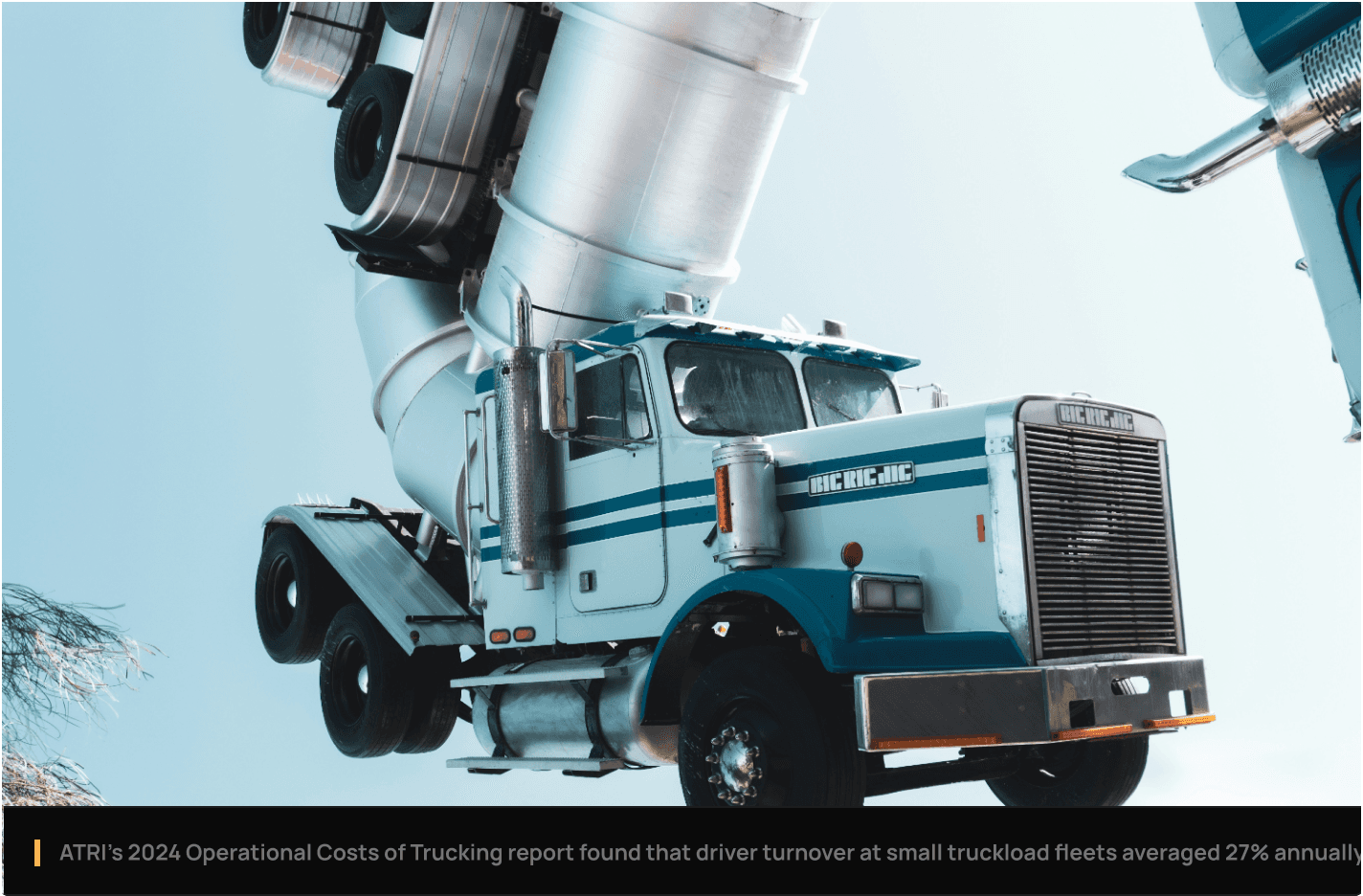
ATRI's 2024 Operational Costs of Trucking report found that driver turnover at small truckload fleets averaged 27% annually. This is a cost that does not appear anywhere in the cost per mile calculation, because it does not happen per mile. It happens per departure.
PDA's 2024 driver job market snapshot puts the cost of replacing a driver at $12,800 — covering recruiting, advertising, background checks, and training. On a 15-truck fleet with 27% annual turnover, roughly 4 driver replacements annually, that is approximately $51,000 per year. This figure doesn't show up in a standard profit and loss statement as a single line item. It is absorbed across recruiting spend, owner time, and operational disruption — which is exactly why most small fleet owners have no idea what they are actually paying.
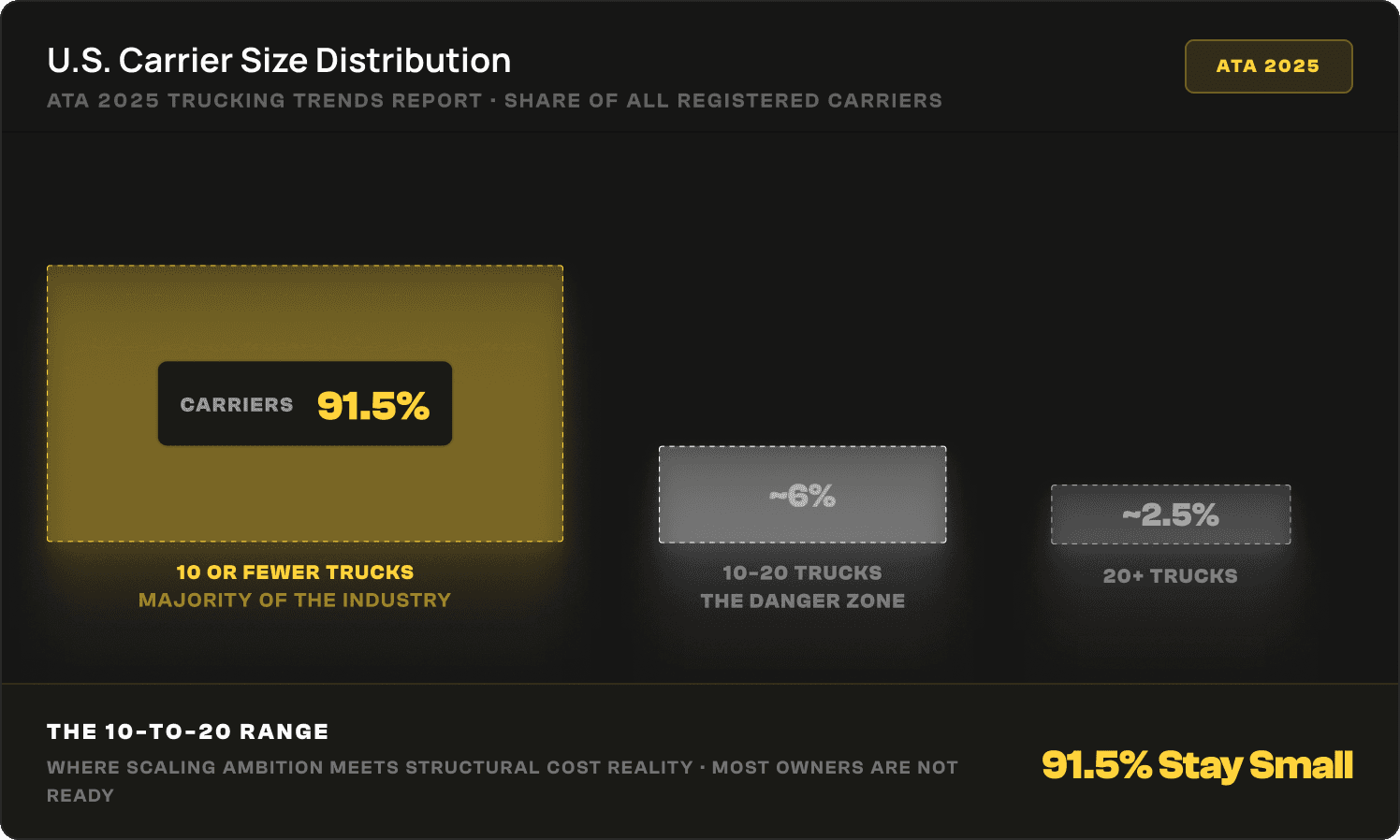
The fleet owners who make the 10-to-20 range work are the ones who treat driver retention as a financial metric, not an HR function. Lower turnover means lower replacement costs, higher service quality, and better shipper relationships. It also means your drivers know your lanes, your customers, and your standards — institutional knowledge that is expensive to rebuild every time someone leaves.
Bottom Line
Scaling a trucking fleet is a legitimate path to building a significant business. But it is not a path that rewards impatience, or owners who will not make the structural transition from driver to manager. The trucks do not build the business. The systems do. Need help building this system, contact -
support@hemut.com
The Overhead That Appears Between Trucks 6 and 10
A single owner-operator's cost structure is relatively simple: truck payment, insurance, fuel, maintenance, permits. When you add a second driver, the structure changes. Add a fifth and the complexity compounds. By truck six, you need dispatch support. By truck ten, you need a full-time dispatcher, a part-time bookkeeper, workers' compensation insurance averaging $6.33 per $100 of payroll, safety management, and technology to coordinate the fleet.
The counterargument — that dispatch can be outsourced and overhead kept minimal at this stage — is partially valid. Dispatch services run 5% to 10% of gross revenue, or $200 to $400 per truck per week. On a 10-truck fleet at $24,400 gross per truck per month, outsourced dispatch costs $11,000 to $24,400 per month. That is comparable to a full-time internal dispatcher plus administrative support, except you have less control and less visibility. The overhead exists either way. The question is whether you have built the revenue base to support it.
What the Per-Truck Math Actually Looks Like
A 15-truck fleet running at $2.44 per mile on 10,000 miles per truck per month generates $366,000 in monthly gross revenue. According to ATRI's 2025 Operational Costs of Trucking report, direct per-truck costs break down as follows: driver wages at $0.798 per mile, driver benefits at $0.197, fuel at $0.480, truck and trailer payments at $0.390, repair and maintenance at $0.198, and insurance at $0.102, totaling $2.165 per mile. Across 15 trucks that is $324,750 in direct costs, leaving $41,250 in contribution margin, or 11.3%. Subtract $24,000 in fleet overhead and net operating income before the owner's salary and taxes is $17,250 per month, or $1,150 per truck.
Now run the scenario at $2.20 per mile, closer to where many contract rates sat in 2024. Monthly revenue drops to $330,000. After $324,750 in direct costs, there is $5,250 left. Overhead consumes all of it and then some, leaving the fleet $18,750 in the red every month. The difference between a profitable fleet and a cash-consuming one is $0.24 per mile. That is thinner than most fleet owners realize when they are buying their fourth or fifth unit.
Companies that effectively right-size their fleets benefit from cost savings, increased flexibility, and improved efficiency. They are better positioned to adapt to market changes without the burden of excess assets.
Jeff Nieman, chief operating officer of Merchants Fleet.
The Driver Problem Nobody Plans For
ATRI's 2024 Operational Costs of Trucking report found that driver turnover at small truckload fleets averaged 27% annually. This is a cost that does not appear anywhere in the cost per mile calculation, because it does not happen per mile. It happens per departure.
PDA's 2024 driver job market snapshot puts the cost of replacing a driver at $12,800 — covering recruiting, advertising, background checks, and training. On a 15-truck fleet with 27% annual turnover, roughly 4 driver replacements annually, that is approximately $51,000 per year. This figure doesn't show up in a standard profit and loss statement as a single line item. It is absorbed across recruiting spend, owner time, and operational disruption — which is exactly why most small fleet owners have no idea what they are actually paying.
The fleet owners who make the 10-to-20 range work are the ones who treat driver retention as a financial metric, not an HR function. Lower turnover means lower replacement costs, higher service quality, and better shipper relationships. It also means your drivers know your lanes, your customers, and your standards — institutional knowledge that is expensive to rebuild every time someone leaves.
Bottom Line
Scaling a trucking fleet is a legitimate path to building a significant business. But it is not a path that rewards impatience, or owners who will not make the structural transition from driver to manager. The trucks do not build the business. The systems do. Need help building this system, contact -
support@hemut.com
The Overhead That Appears Between Trucks 6 and 10
A single owner-operator's cost structure is relatively simple: truck payment, insurance, fuel, maintenance, permits. When you add a second driver, the structure changes. Add a fifth and the complexity compounds. By truck six, you need dispatch support. By truck ten, you need a full-time dispatcher, a part-time bookkeeper, workers' compensation insurance averaging $6.33 per $100 of payroll, safety management, and technology to coordinate the fleet.
The counterargument — that dispatch can be outsourced and overhead kept minimal at this stage — is partially valid. Dispatch services run 5% to 10% of gross revenue, or $200 to $400 per truck per week. On a 10-truck fleet at $24,400 gross per truck per month, outsourced dispatch costs $11,000 to $24,400 per month. That is comparable to a full-time internal dispatcher plus administrative support, except you have less control and less visibility. The overhead exists either way. The question is whether you have built the revenue base to support it.
What the Per-Truck Math Actually Looks Like
A 15-truck fleet running at $2.44 per mile on 10,000 miles per truck per month generates $366,000 in monthly gross revenue. According to ATRI's 2025 Operational Costs of Trucking report, direct per-truck costs break down as follows: driver wages at $0.798 per mile, driver benefits at $0.197, fuel at $0.480, truck and trailer payments at $0.390, repair and maintenance at $0.198, and insurance at $0.102, totaling $2.165 per mile. Across 15 trucks that is $324,750 in direct costs, leaving $41,250 in contribution margin, or 11.3%. Subtract $24,000 in fleet overhead and net operating income before the owner's salary and taxes is $17,250 per month, or $1,150 per truck.
Now run the scenario at $2.20 per mile, closer to where many contract rates sat in 2024. Monthly revenue drops to $330,000. After $324,750 in direct costs, there is $5,250 left. Overhead consumes all of it and then some, leaving the fleet $18,750 in the red every month. The difference between a profitable fleet and a cash-consuming one is $0.24 per mile. That is thinner than most fleet owners realize when they are buying their fourth or fifth unit.
Companies that effectively right-size their fleets benefit from cost savings, increased flexibility, and improved efficiency. They are better positioned to adapt to market changes without the burden of excess assets.
Jeff Nieman, chief operating officer of Merchants Fleet.
The Driver Problem Nobody Plans For
ATRI's 2024 Operational Costs of Trucking report found that driver turnover at small truckload fleets averaged 27% annually. This is a cost that does not appear anywhere in the cost per mile calculation, because it does not happen per mile. It happens per departure.
PDA's 2024 driver job market snapshot puts the cost of replacing a driver at $12,800 — covering recruiting, advertising, background checks, and training. On a 15-truck fleet with 27% annual turnover, roughly 4 driver replacements annually, that is approximately $51,000 per year. This figure doesn't show up in a standard profit and loss statement as a single line item. It is absorbed across recruiting spend, owner time, and operational disruption — which is exactly why most small fleet owners have no idea what they are actually paying.
The fleet owners who make the 10-to-20 range work are the ones who treat driver retention as a financial metric, not an HR function. Lower turnover means lower replacement costs, higher service quality, and better shipper relationships. It also means your drivers know your lanes, your customers, and your standards — institutional knowledge that is expensive to rebuild every time someone leaves.
Bottom Line
Scaling a trucking fleet is a legitimate path to building a significant business. But it is not a path that rewards impatience, or owners who will not make the structural transition from driver to manager. The trucks do not build the business. The systems do. Need help building this system, contact -
support@hemut.com
Transform your freight operations and leap ahead of the competition.
© Hemut co All Rights Reserved 2026
Transform your freight operations and leap ahead of the competition.
© Hemut co All Rights Reserved 2026
Transform your freight operations and leap ahead of the competition.
© Hemut co All Rights Reserved 2026